Torrey Canyon
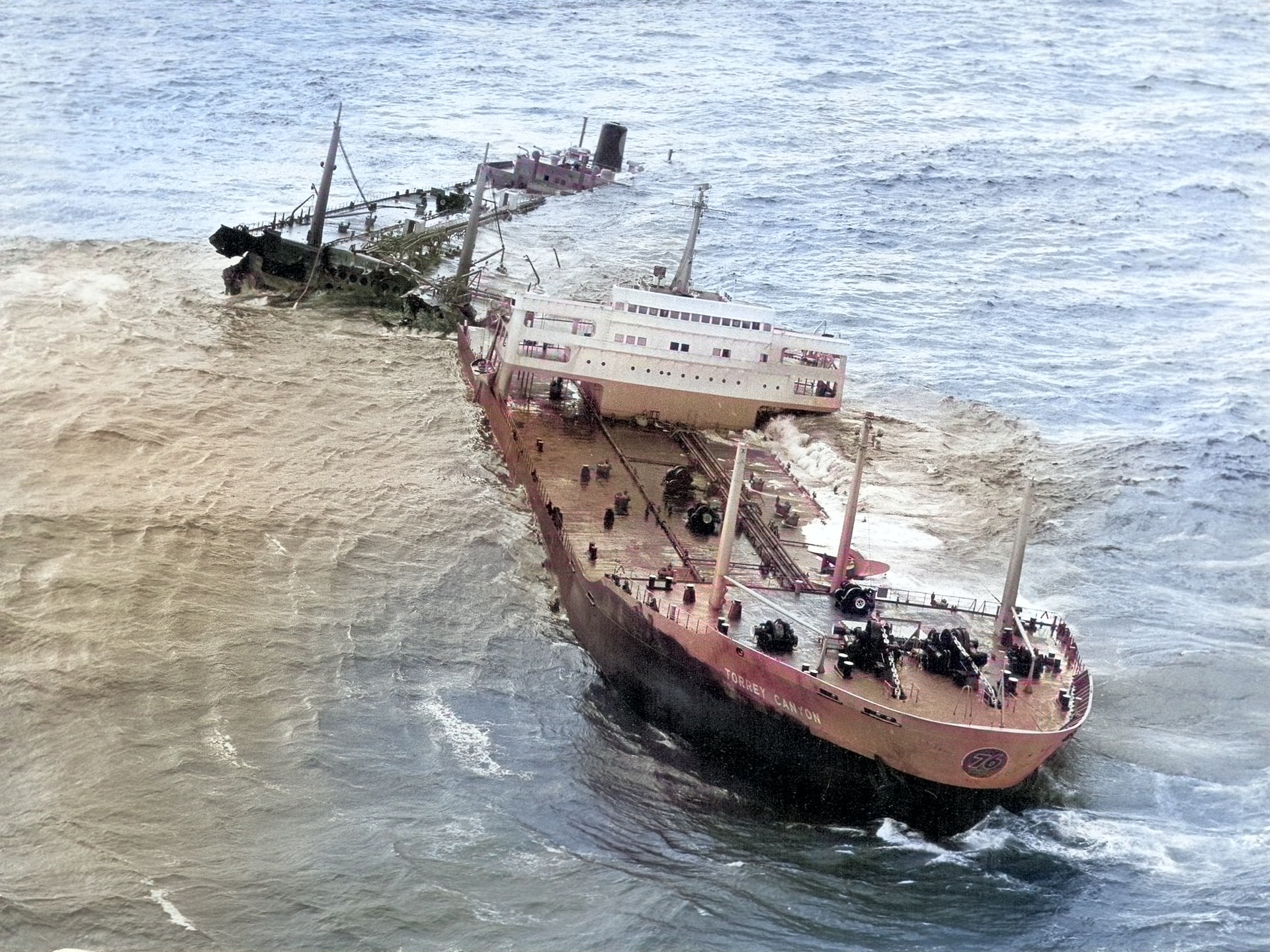
On the morning of 18 March 1967, the supertanker Torrey Canyon struck Pollard's Rock on the Seven Stones reef between the Isles of Scilly and Land's End. She was carrying 119,328 tons of crude oil from Kuwait to Milford Haven. Within hours the first oil began to leak into the Atlantic. Within days it would become the worst oil disaster the world had yet seen.
The ship had been lengthened in 1964 at a Japanese shipyard, her hull cut in two and a new midsection welded in to nearly double her capacity. She sailed under a Liberian flag of convenience with an Italian crew. Her captain, Pastrengo Rugiati, was attempting to reach Milford Haven before high tide.
The British government, confronted with an unprecedented disaster and no legal framework for dealing with it, improvised. Harold Wilson ordered the RAF to bomb the wreck with napalm in an attempt to burn off the remaining oil. It took three days of bombing. The beaches of Cornwall were sprayed with industrial detergents that proved more toxic than the oil itself.
The crude oil she carried had formed in the shallow waters of the Tethys Sea during the Cretaceous period, roughly 100 million years ago. The oil's journey from the Cretaceous seabed to the Cornish coastline traces a line through deep time — from the death of plankton in a vanished ocean to the wreck of a supertanker on a granite reef.